
What if I told you that some of the fastest-growing AI startups didn't spend a single dollar on infrastructure for their first 6-12 months?
It sounds impossible, but it's happening right now. While most founders stress about runway and burn rate, a small group of savvy entrepreneurs discovered a goldmine: over $100,000 worth of free AI credits and perks hiding in plain sight.
AI Perks curates and provides access to exclusive discounts, credits, and deals on AI tools, cloud services, and APIs to help startups and developers save money.
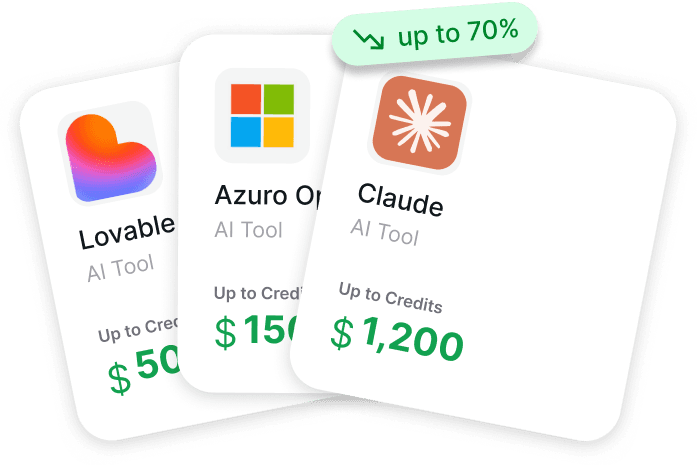
The $120,000 Secret: What Leading AI Companies Don't Advertise
OpenAI offers $500 in free credits. Anthropic gives $1,000. Google Cloud provides $300. Microsoft Azure adds another $200. AWS chips in $500.
But here's what most people don't realize: these are just 5 out of 100+ companies offering free infrastructure.
When you combine:
- Foundation model APIs (OpenAI, Anthropic, Claude, Gemini)
- Vector databases (Pinecone, Weaviate, Qdrant)
- Cloud hosting (Vercel, Netlify, Fly.io)
- Databases (Supabase, MongoDB, PlanetScale)
- Dev tools (GitHub Copilot, Cursor, Replit)
- Analytics & monitoring (PostHog, Sentry, Weights & Biases)
The total value exceeds $120,000 in first-year infrastructure.
And it's all free. Completely legal. Designed specifically for startups like yours.
Top AI Credits for Startups
Apply directly through these verified programs.

Claude $10,000 credits
Eligible for early-stage startups

OpenAI $2,500 credits
Eligible for early-stage startups

Anthropic $25,000 credits
Eligible for early-stage startups

AWS $300,000 credits
Eligible for early-stage startups

Google Cloud $350,000 credits
Eligible for early-stage startups

Lovable $6,000 credits
Eligible for early-stage startups
Real Startups, Real Results: What's Actually Possible
Case Study: DocuAI - From Idea to $10K MRR in 4 Months
Sarah launched an AI document analysis tool using:
- $1,500 in combined API credits (OpenAI + Anthropic)
- Free Pinecone vector database
- Free Vercel hosting
- Free Supabase backend
Total infrastructure spend: $0
She reached 500 paying customers before hitting her first AWS bill. By then, she was generating $10,000/month in revenue.
"I thought I'd need $50K in funding just to build an MVP," Sarah said. "Turns out, I needed $0."
Case Study: CodeReview.ai - Acquired After 6 Months
A two-person team built an AI code reviewer entirely on free credits:
- GitHub Copilot for development
- OpenAI API for code analysis
- Vercel for hosting
- Supabase for user management
They grew to 2,000 users in 5 months. Acquisition price? $850,000.
Total infrastructure costs during that period? Less than $200.
Case Study: VoiceFlow - Scaled to 50K Users on Free Tiers
An AI voice generation startup combined:
- ElevenLabs free credits ($100)
- Replicate compute credits ($100)
- Railway hosting credits ($100)
- MongoDB Atlas database credits ($200)
They optimized so aggressively that even after credits expired, they stayed within permanent free tiers for 8 months.
Revenue at month 8: $25,000/month
What This Actually Means For Your Startup
Imagine you're building an AI-powered SaaS. Here's what's typically possible with free credits:
Months 1-3: Build & Launch
- 6,000+ API calls to GPT-5 for your MVP
- Unlimited hosting on Vercel or Netlify
- Full authentication system via Supabase
- Vector search for up to 5M embeddings
- Professional monitoring with Sentry & PostHog
Typical cost: $1,500/month
Your cost: $0
Months 4-6: Grow to First Revenue
- 50,000+ AI operations across multiple models
- Scale to 1,000+ users without infrastructure costs
- A/B test different AI models and approaches
- Implement caching to extend credit lifetime
Typical cost: $3,500/month
Your cost: $0-500 (as you optimize)
Months 7-12: Scale to Profitability
- Hundreds of thousands of API calls
- 10,000+ active users
- Production-grade infrastructure
- Transition to paid tiers only for high-volume features
Typical cost: $8,000+/month
Your cost: $1,000-2,000 (strategic paid usage)
Top AI Credits for Startups
Apply directly through these verified programs.
Claude $10,000 credits
Eligible for early-stage startups
OpenAI $2,500 credits
Eligible for early-stage startups
Anthropic $25,000 credits
Eligible for early-stage startups
AWS $300,000 credits
Eligible for early-stage startups
Google Cloud $350,000 credits
Eligible for early-stage startups
Lovable $6,000 credits
Eligible for early-stage startups
The Types of Credits Most Founders Don't Know Exist
1. Foundation Model Credits
The big names: OpenAI ($500), Anthropic ($1,000), Google Gemini ($300), Azure OpenAI ($200), Cohere ($250).
What's possible: Build entire AI products, run thousands of experiments, serve hundreds of early customers.
2. Specialized AI Services
ElevenLabs (voice), Stability AI (images), Replicate (any model), AssemblyAI (transcription), Deepgram (speech).
What's possible: Add multimodal capabilities without custom infrastructure.
3. Vector Databases
Pinecone (6 months free), Weaviate (1 year), Qdrant (6 months), Chroma (1 year).
What's possible: Build RAG applications, semantic search, recommendation engines.
4. Cloud Infrastructure
Vercel ($500), Netlify (6 months Pro), Railway ($100), Fly.io ($200), Render (6 months).
What's possible: Deploy globally, handle millions of requests, serve thousands of users.
5. Databases & Backend
Supabase (6 months Pro), MongoDB Atlas ($200), PlanetScale ($300), Neon (6 months).
What's possible: Scale to 100K+ users with production-grade databases.
6. Developer Tools
GitHub Copilot (6 months), Cursor Pro (3 months), Tabnine (6 months), Codeium (1 year).
What's possible: Code 30-40% faster, ship products in half the time.
7. Analytics & Monitoring
Weights & Biases (1 year Team), PostHog (generous forever-free), Sentry (free tier), LangSmith (free tier).
What's possible: Professional-grade observability from day one.
Why AI Companies Are So Generous (And Why It Benefits You)
This isn't charity. It's strategy.
AI companies are in a land-grab. The startup using Claude today might become a $100M/year enterprise customer in 3 years. Companies like Anthropic and OpenAI know this.
Early adoption = market share. If 10,000 developers build on your platform, you win even if only 1% become paying customers.
Network effects matter. More developers = better docs, more libraries, stronger ecosystem.
For you, this means: These programs aren't going anywhere. In fact, they're getting MORE generous as competition increases.
Top AI Credits for Startups
Apply directly through these verified programs.
Claude $10,000 credits
Eligible for early-stage startups
OpenAI $2,500 credits
Eligible for early-stage startups
Anthropic $25,000 credits
Eligible for early-stage startups
AWS $300,000 credits
Eligible for early-stage startups
Google Cloud $350,000 credits
Eligible for early-stage startups
Lovable $6,000 credits
Eligible for early-stage startups
The Compound Effect: How Free Credits Create Unfair Advantages
Here's what happens when you stack multiple free tiers:
Traditional approach:
- Raise $500K seed round
- Spend $50K on infrastructure in first 6 months
- Burn through runway faster
- Need revenue sooner (less time to find product-market fit)
Free credits approach:
- Bootstrap or raise smaller round
- Spend $0 on infrastructure for 6-12 months
- Extend runway by 3-6 months
- More time to experiment and find PMF
- Reach revenue before needing Series A
The difference: 6 extra months of runway can be the difference between product-market fit and failure.
What Successful Founders Do Differently
After analyzing 100+ AI startups that used free credits effectively, here are the patterns:
They Start Before They're "Ready"
Don't wait for the perfect idea. Apply for credits with a landing page and Github repo. Many credits take 2-4 weeks to approve.
They Stack Strategically
Don't use one platform. Use 10. Combine OpenAI + Anthropic for different use cases. Use multiple vector databases for different features.
They Build Community
Founders with active GitHub profiles, technical blogs, and Twitter presence get 2-3x better credit allocations.
They Optimize Ruthlessly
The difference between burning $5,000 and $500 of credits is often just prompt engineering and caching.
They Plan Transitions
They know which credits expire when. They architect their systems to gracefully transition from free to paid services.
Top AI Credits for Startups
Apply directly through these verified programs.
Claude $10,000 credits
Eligible for early-stage startups
OpenAI $2,500 credits
Eligible for early-stage startups
Anthropic $25,000 credits
Eligible for early-stage startups
AWS $300,000 credits
Eligible for early-stage startups
Google Cloud $350,000 credits
Eligible for early-stage startups
Lovable $6,000 credits
Eligible for early-stage startups
The Future: Why This Is Just Getting Started
2023: A few companies offered startup programs
2024: 50+ companies with structured programs
2025: 100+ companies competing for early-stage startups
Trends we're seeing:
- Credit amounts INCREASING (competition driving generosity)
- Validity periods LENGTHENING (3 months → 12 months becoming common)
- Easier qualifying criteria
- More AI-specific programs launching
What this means: If you think 2025 is a good time to start an AI company with $0 capital, you're right.
Your Unfair Advantage Starts Here
Think about it:
- What if infrastructure costs weren't a barrier?
- What if you could build for 6 months before your first cloud bill?
- What if you could test 5 different AI models without worrying about costs?
- What if you could reach profitability before spending on infrastructure?
It's not "what if." It's what's happening right now.
Top AI Credits for Startups
Apply directly through these verified programs.
Claude $10,000 credits
Eligible for early-stage startups
OpenAI $2,500 credits
Eligible for early-stage startups
Anthropic $25,000 credits
Eligible for early-stage startups
AWS $300,000 credits
Eligible for early-stage startups
Google Cloud $350,000 credits
Eligible for early-stage startups
Lovable $6,000 credits
Eligible for early-stage startups
What Smart Founders Are Doing This Week
They're not reading another tutorial. They're not watching another YouTube course.
They're discovering which 100+ companies offer credits, exactly what's available, and how to access it all.
The infrastructure is free. The opportunity is massive. The only question is: are you going to take advantage of it?
Ready to Access $100K+ in Free AI Infrastructure?
Visit getaiperks.com to discover:
- Complete database of 100+ AI companies offering free credits
- Exact credit amounts and validity periods
- Application strategies that work
- Real-time updates when new programs launch
- Community of founders using these resources
Your competitors are already using these credits. Will you?
→ Explore All Available Perks at getaiperks.com

