
AI Perks curates and provides access to exclusive discounts, credits, and deals on AI tools, cloud services, and APIs to help startups and developers save money.
Claude Opus 4.7: The New SWE-bench Champion in 2026
Claude Opus 4.7 launched on April 16, 2026, pricing at $5 per million input tokens and $25 per million output tokens. It hit 87.6% on SWE-bench Verified - the highest of any frontier model in 2026. The previous version, Opus 4.6, had been state-of-the-art for only ~50 days.
Anthropic has shipped four major Claude updates in roughly 50 days as of May 2026: Sonnet 4.5, Sonnet 4.6, Opus 4.6, and now Opus 4.7. The release cadence is the fastest in frontier AI. For developers, the question is how to access Opus 4.7 without burning runway at $25 per million output tokens. AI Perks covers the credit programs that fund Opus usage at zero cost.
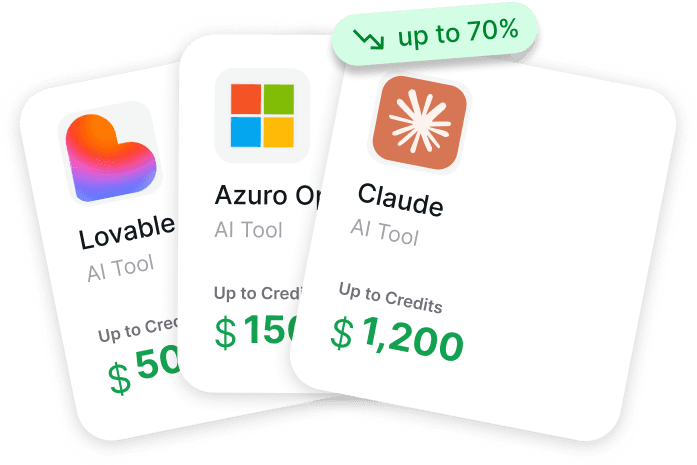
Top AI Credits for Startups
Apply directly through these verified programs.

Claude $10,000 credits
Eligible for early-stage startups

OpenAI $2,500 credits
Eligible for early-stage startups

Anthropic $25,000 credits
Eligible for early-stage startups

AWS $300,000 credits
Eligible for early-stage startups

Google Cloud $350,000 credits
Eligible for early-stage startups

Lovable $6,000 credits
Eligible for early-stage startups
Claude Opus 4.7 Pricing in Context
| Model | Input/1M | Output/1M | Cache Hit Input |
|---|---|---|---|
| Claude Haiku 4.5 | $1.00 | $5.00 | $0.10 |
| Claude Sonnet 4.6 | $3.00 | $15.00 | $0.30 |
| Claude Opus 4.7 | $5.00 | $25.00 | $0.50 |
| GPT-5.5 | $5.00 | $30.00 | $1.25 |
| Grok 4 Heavy | $15.00 | $75.00 | N/A |
Opus 4.7 dropped 67% in output price vs the previous Opus 4.6 ($75 → $25). This is the biggest single price cut Anthropic has ever shipped on a flagship model. It directly responds to GPT-5.5's $30 output and undercuts both meaningfully.
What Opus 4.7 Is Best For
The benchmark gains are concentrated in reasoning and coding:
- SWE-bench Verified: 87.6% (vs Opus 4.6 at 80.2%, vs GPT-5.5 at 79.8%)
- AIME math: 94.1% (frontier-leading)
- GPQA Diamond: 91.3%
- Tool use reliability: industry-leading on long tool chains
- Long context: 200K tokens with strong recall
For agent products, complex coding tasks, and hard reasoning, Opus 4.7 is the new reference. For everything else, Sonnet 4.6 at $3/$15 is the cost-effective default.
Top AI Credits for Startups
Apply directly through these verified programs.
Claude $10,000 credits
Eligible for early-stage startups
OpenAI $2,500 credits
Eligible for early-stage startups
Anthropic $25,000 credits
Eligible for early-stage startups
AWS $300,000 credits
Eligible for early-stage startups
Google Cloud $350,000 credits
Eligible for early-stage startups
Lovable $6,000 credits
Eligible for early-stage startups
How to Get Free Claude Opus 4.7 Credits
| Source | Available Credits | How to Get |
|---|---|---|
| New Anthropic API trial | $5 - $50 | Direct signup |
| Anthropic startup program | $1,000 - $25,000+ | AI Perks Guide |
| Bundled cloud founder programs | $5,000 - $100,000+ | AI Perks Guide |
| Research and education credits | $500 - $25,000+ | AI Perks Guide |
| Hackathon partner credits | $50 - $500 | Event-dependent |
Total potential: $5,500 - $150,000+ in stacked Anthropic credits
The exact program names, eligibility windows, and application order are inside AI Perks. The AI Perks team comes from Y Combinator, Techstars, Antler, 500 Global, and Google for Startups.
Opus 4.7 Real-World Cost Math
| Workload | Tokens/Month | Cost at Retail |
|---|---|---|
| Personal Claude Code (4hr/day) | 30M in + 15M out | $525/month |
| Team agent product | 200M in + 100M out | $3,500/month |
| Heavy production (multiple agents) | 1B in + 500M out | $17,500/month |
| Research lab (eval-heavy) | 500M in + 200M out | $7,500/month |
A solo developer running Claude Code on Opus 4.7 burns ~$500/month at retail. With $1,000+ in free Anthropic credits via AI Perks, that is 2+ months of runway. With $25,000+ in stacked credits, that is 4+ years of personal use.
Top AI Credits for Startups
Apply directly through these verified programs.
Claude $10,000 credits
Eligible for early-stage startups
OpenAI $2,500 credits
Eligible for early-stage startups
Anthropic $25,000 credits
Eligible for early-stage startups
AWS $300,000 credits
Eligible for early-stage startups
Google Cloud $350,000 credits
Eligible for early-stage startups
Lovable $6,000 credits
Eligible for early-stage startups
When to Use Opus 4.7 vs Sonnet 4.6
Use Opus 4.7 When
- Hardest reasoning tasks - math, complex code, multi-step planning
- Long-running agents where one error breaks the chain
- High-stakes outputs - legal, medical, financial analysis
- Research-grade evaluation - benchmarks, novel task design
- You have free credits - cost-no-object scenarios
Use Sonnet 4.6 When
- 80% of daily coding - autocomplete, refactors, mid-complexity tasks
- Production chatbots - good-enough reasoning at 60% cost
- Long-context document analysis - 200K-token summaries
- Multi-agent coordination - Sonnet handles tool chains well
Use Haiku 4.5 When
- Cheap volume tasks - classifiers, simple summaries, commit messages
- Pre-filtering before sending to Sonnet or Opus
- Cost-sensitive at extreme scale - millions of requests/month
Stacking Strategy
Solo Developer Stack ($1,500+)
- New API trial: $5-$50
- Free Anthropic credits via startup program: $1,000+
- Free OpenAI as fallback: $300+
- Total: $1,500+ in offsets
Production Stack ($35,000+)
- Bundled Anthropic credits: $25,000+
- Bundled cloud founder programs: $5,000+
- Cross-provider redundancy: $5,000+
- Total: $35,000+ in offsets
Research Lab Stack ($50,000+)
- Anthropic research credit program: $5,000-$25,000+
- Anthropic startup credits: $25,000+
- University AI partnerships: $1,000-$10,000
- Total: $50,000+ in offsets
Top AI Credits for Startups
Apply directly through these verified programs.
Claude $10,000 credits
Eligible for early-stage startups
OpenAI $2,500 credits
Eligible for early-stage startups
Anthropic $25,000 credits
Eligible for early-stage startups
AWS $300,000 credits
Eligible for early-stage startups
Google Cloud $350,000 credits
Eligible for early-stage startups
Lovable $6,000 credits
Eligible for early-stage startups
Step-by-Step: Run Claude Opus 4.7 for Near-Zero Cost
Step 1: Get free credits via AI Perks for Anthropic startup and research programs.
Step 2: Generate an API key at console.anthropic.com and link to your free-credit account.
Step 3: Use Claude Code with Opus 4.7 as the default for hard tasks (/model opus).
Step 4: Enable prompt caching on stable system prompts - cuts effective input cost by 60-80%.
Step 5: Route routine work to Sonnet 4.6 to extend Opus credit runway.
Caveats and Hidden Costs
- Rate limits scale with tier - free trial caps are tight, increase with usage history
- Cache invalidation - small system prompt changes invalidate cache, doubling cost briefly
- Extended thinking adds output tokens - thinking tokens count toward output budget
- Long context costs more - 200K-token requests cost more than chunked 50K requests
- Credits expire - typically 6-12 months from grant date
- Batch API gives 50% discount - use for non-real-time workloads
Top AI Credits for Startups
Apply directly through these verified programs.
Claude $10,000 credits
Eligible for early-stage startups
OpenAI $2,500 credits
Eligible for early-stage startups
Anthropic $25,000 credits
Eligible for early-stage startups
AWS $300,000 credits
Eligible for early-stage startups
Google Cloud $350,000 credits
Eligible for early-stage startups
Lovable $6,000 credits
Eligible for early-stage startups
Frequently Asked Questions
How much does Claude Opus 4.7 cost?
Claude Opus 4.7 costs $5 per million input tokens and $25 per million output tokens. This is a 67% price cut from Opus 4.6's $75 output pricing. Free credits via AI Perks cover production-scale usage.
Is Opus 4.7 better than GPT-5.5?
On benchmarks, yes. Opus 4.7 leads on SWE-bench (87.6% vs 79.8%), AIME math, and tool use reliability. GPT-5.5 has advantages on multimodal and broader ecosystem. Most teams use both with free credits from AI Perks.
When did Opus 4.7 launch?
Claude Opus 4.7 launched on April 16, 2026. It replaced Opus 4.6 which had been state-of-the-art for roughly 50 days. The Anthropic release cadence in 2026 is the fastest in frontier AI.
Can I get free Opus 4.7 credits as a startup?
Yes, Anthropic's startup credit program is active with credits up to $25,000+ for qualifying companies. Bundled founder programs add additional credits. Combined potential reaches $150,000+. Application playbook at AI Perks.
Opus 4.7 vs Sonnet 4.6 - which should I use?
Default to Sonnet 4.6 for 80% of tasks (cheaper, fast, still excellent). Escalate to Opus 4.7 for hardest reasoning, complex code, and high-stakes outputs. Free credits for both stack at AI Perks.
Does Claude Code use Opus 4.7 by default?
Claude Code defaults to Sonnet 4.6 for cost reasons. Switch to Opus 4.7 with /model claude-opus-4-7 for individual sessions or configure as default in your Claude Code settings. Use free credits via AI Perks to make it sustainable.
Why did Anthropic cut Opus pricing 67%?
The cut directly responds to GPT-5.5 doubling to $30 output. By pricing Opus 4.7 at $25, Anthropic both undercuts OpenAI on the flagship comparison and signals confidence in compute efficiency gains. Developer-friendly pricing also drives faster adoption.
The Bottom Line on Opus 4.7
Opus 4.7 is the new benchmark champion at a developer-friendly price. The 67% output price cut makes it the cheapest top-tier frontier model in 2026. Combined with free Anthropic startup and research credits from AI Perks, it runs at $0 effective cost for 6-12 months of serious production work.
Stop paying retail for Claude Opus 4.7. Get $5,500-$150,000+ in stacked credits at getaiperks.com.

