
AI Perks curates and provides access to exclusive discounts, credits, and deals on AI tools, cloud services, and APIs to help startups and developers save money.
How much free cloud credit can a student get?
A student can start with $100 in Azure credits and no credit card at sign-up, then add Google Cloud and AWS education credits. Catalogue values for cloud perks run up to $350,000.
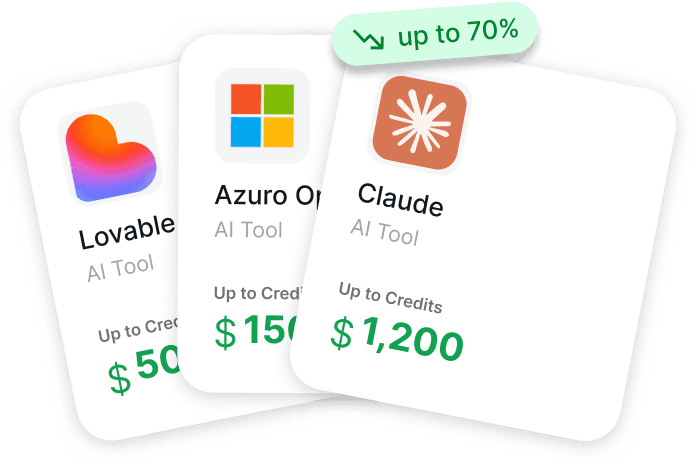
The Azure card shows who qualifies and how to claim. AI Perks tracks many more student offers than this page can list, so treat the ranking below as a starting point rather than the full picture.
The page is grouped by use: what is free for everyone, then student upgrades, then the larger catalogue values for serious projects. Here is the quick view.
| Option | Amount | Credit card? |
|---|---|---|
| Azure student credit | $100, renewable yearly | Not needed at sign-up |
| Azure for new customers (not student-specific) | $1,000 instantly, up to $5,000 | Not stated |
| Google Cloud teaching credits | Up to $50 per student | Not needed, per Google |
| Google Skills credits | 200 credits | Not stated |
| AWS credits (one university's listing) | $100 per student, renewed annually | Card details at setup |
| Google Cloud credit (Michigan's student page) | $300 | Required |
The table shows the main trade-off. The smallest amounts are the easiest to start, while the larger ones usually come with a credit card or a faculty member in the middle.
Top AI Credits for Startups
Apply directly through these verified programs.

ChatGPT $80
Eligible for early-stage startups

Google Gemini $240
Eligible for early-stage startups

GitHub Up to $120
Eligible for early-stage startups

Notion $120
Eligible for early-stage startups

Figma $1,080
Eligible for early-stage startups

Perplexity $84
Eligible for early-stage startups
What is free for everyone, student or not?
Start with usage that needs no student status. Pair it with the $100 in Azure credits and your first project may cost nothing.
Azure lists 65+ always-free services with free monthly amounts, and 20+ popular services with free monthly amounts for new Azure customers. New customers can also take $1,000 in Azure credits instantly with no application, and unlock up to $5,000 in total with business verification.
Google works the same way. Free-tier Google Cloud products do not count against your education credits, so a small app can run on the free tier while the credits sit untouched. Students also get no-cost access to hands-on labs on Google's student page.
This matters for planning. A class project, a portfolio site or a small API often fits inside free monthly amounts, which means your credit balance stays available for the day you need a bigger database or a GPU-heavy experiment.
Azure: the best first cloud credit for students
Rank one is $100 in Azure credits because it asks for no credit card at sign-up and works on most Azure products. The card shows who qualifies and how to claim, and AI Perks tracks more student offers beside it.
The student subscription includes more than 25 free services covering compute, network, storage and databases. Students can renew each year they are active and get another $100. Students with an active subscription can also download certain developer tools for free.
That renewal is the quiet advantage. Over two active years the credit adds up to $200 ($100 + $100), and you keep the same account, so a project you started in the first year does not have to move.
Two cautions. Only one student subscription is allowed per eligible customer, and Microsoft says the offer has limited activations and is available only while supplies last. If you want it, do not wait for next semester.
Top AI Credits for Startups
Apply directly through these verified programs.
ChatGPT $80
Eligible for early-stage startups
Google Gemini $240
Eligible for early-stage startups
GitHub Up to $120
Eligible for early-stage startups
Notion $120
Eligible for early-stage startups
Figma $1,080
Eligible for early-stage startups
Perplexity $84
Eligible for early-stage startups
Google Cloud: teaching credits, lab credits and a $300 option
The catalogue headline is $350,000 in Google Cloud credits, which is a project-scale figure, not a typical student amount. The card shows who qualifies and how to claim, and AI Perks tracks the smaller student routes too.
At student level, education credits come through faculty: up to $100 per teaching staff member and up to $50 per student. Students on a group project can pool their individual credits. Anyone who needs more must ask their faculty member.
Pooling is worth a moment of arithmetic. A team of four students that each hold $50 has $200 to share ($50 x 4), enough room for a shared database and a test environment without anyone paying out of pocket.
Google also offers students 200 free Google Skills credits, and the University of Michigan says its students may sign up for a $300 Google Cloud credit. That $300 option requires a credit card, unlike education credits. Google tells faculty to stop students from signing up for the card-based free trial by accident, so read the screen before you enter payment details.
AWS and DigitalOcean: bigger values for real projects
Once the course work becomes a real product, look at $300,000 in AWS credits. The card shows who qualifies and how to claim, and the catalogue keeps growing as AI Perks adds student offers.
At student level, Princeton lists AWS credits at $250 per faculty member and $100 per student, renewed annually. Princeton also says accounts need a school email address and credit card information at setup. That is a real difference from the Azure route, where no card is needed at sign-up.
DigitalOcean is the other large entry worth a look, with $100,000 in credits in the catalogue. Like the other big figures, it is aimed at funded projects rather than a weekend assignment, so use it as the target to grow toward, not as the first thing you try.
The pattern across all three clouds is the same. Small student credits are easy to reach and good for learning, and the five and six figure catalogue amounts are there when a project outgrows them.
Top AI Credits for Startups
Apply directly through these verified programs.
ChatGPT $80
Eligible for early-stage startups
Google Gemini $240
Eligible for early-stage startups
GitHub Up to $120
Eligible for early-stage startups
Notion $120
Eligible for early-stage startups
Figma $1,080
Eligible for early-stage startups
Perplexity $84
Eligible for early-stage startups
Which student cloud credits add up to the most?
The table below lists the three cloud perks with the largest catalogue amounts next to the student-level credit, so you can see both ends of the range.
| Company | Free credits | How to get |
|---|---|---|
| Microsoft Azure | $100 | Get this perk |
| Google Cloud | $350,000 | Get this perk |
| AWS | $300,000 | Get this perk |
Total across these three: $650,100 ($100 + $350,000 + $300,000).
Most students will never need the top figures, and that is fine. The point of the table is that one catalogue gives you a ladder: begin with the small credit, learn the platform, and move up when the project is real.
How do you get started step by step?
Follow this order and you will spend the least time and money.
Step 1: Get credits via AI Perks. Open getaiperks.com, find the cloud perks and open the card for the one you want. Each card opens in place, shows who qualifies and how to claim, and is where you sign up and start.
Step 2: Start with the no-card option. Take the $100 in Azure credits first, since it needs no credit card at sign-up. That lets you test a real workload before any payment details are involved.
Step 3: Use the free tiers first. Run small services on always-free amounts, such as the 65+ Azure services or the Google Cloud free tier, so your credits are spent only on things that need them.
Step 4: Ask faculty about education credits. Google and AWS student credits are described as coming through faculty, so a short message to your instructor can unlock $50 or $100 per student.
Step 5: Watch for card-based trials. Before you type payment details, check whether the screen is a credit card trial. The Michigan $300 option requires a card, and Princeton says AWS setup needs card information.
Step 6: Come back when you outgrow it. If your project grows, return to the catalogue and look at the larger amounts, such as $350,000 in Google Cloud credits.
Top AI Credits for Startups
Apply directly through these verified programs.
ChatGPT $80
Eligible for early-stage startups
Google Gemini $240
Eligible for early-stage startups
GitHub Up to $120
Eligible for early-stage startups
Notion $120
Eligible for early-stage startups
Figma $1,080
Eligible for early-stage startups
Perplexity $84
Eligible for early-stage startups
FAQ
Do students need a credit card for free cloud credits?
It depends on the route. The Azure student credit needs no credit card at sign-up, and Google says teaching credits do not require one. The Michigan $300 Google option and AWS setup at Princeton do ask for card details. Check each card at getaiperks.com before you start.
How much is the Azure student credit?
The Azure student credit is $100 in Azure credits, and students can renew each year they are active to get another $100. It also includes more than 25 free services. Microsoft notes limited activations, available only while supplies last, so do not wait.
Can a student group combine Google Cloud credits?
Yes. Students on a group project can pool their individual education credits, which are up to $50 per student. Four students at that level would have $200 together. Anyone who needs more must ask their faculty member. The Google Cloud card at getaiperks.com explains how to claim.
Do free-tier services use up my credits?
No. Free-tier Google Cloud products do not count against your education credits. Azure also lists 65+ always-free services with free monthly amounts. Running small workloads on those tiers keeps your credit balance untouched for heavier work later.
What are the biggest cloud credits in the catalogue?
The largest cloud amounts are $350,000 in Google Cloud credits, $300,000 in AWS credits and $100,000 in DigitalOcean credits. They are project-scale figures, not typical student amounts. See each card for who qualifies.
How many AWS credits do students get?
Princeton lists AWS credits at $250 per faculty member and $100 per student, renewed annually. Accounts need a school email address and credit card information at setup. Other schools may list different amounts, so open the AWS card at getaiperks.com for the current details.
Ready to claim your cloud credits?
Pick the cloud you want to learn, open its card and start with the credit that needs the least from you. When the project grows, the bigger amounts are already in the same place.
Get free AI credits at getaiperks.com →
Browse every free cloud and AI credit in one place at getaiperks.com.

