
There's a parallel universe of AI startups you've never heard of.
They're not in TechCrunch. They don't have Series A announcements. Most raised less than $50K (or $0).
But they're building AI products that generate $10K-50K in monthly revenue, serving thousands of users, and running on infrastructure that would typically cost $5,000+/month.
Their secret? They discovered the hidden ecosystem.
AI Perks poskytuje prístup k exkluzívnym zľavám, kreditom a ponukám na AI nástroje, cloudové služby a API, aby pomohol startupom a vývojárom ušetriť peniaze.
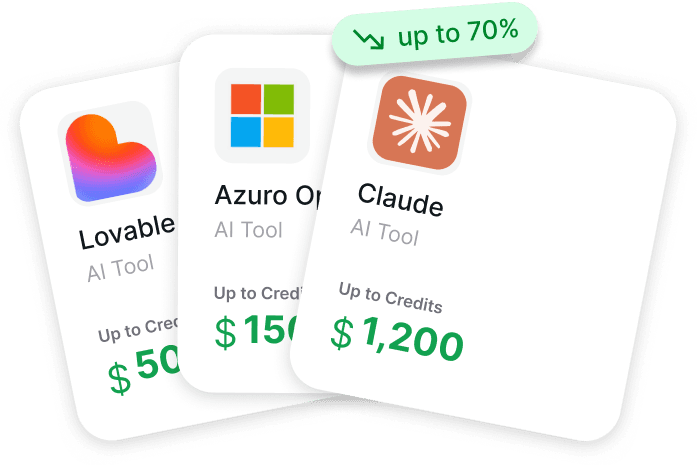
The $120,000 Question Nobody's Asking
Here's a question that should blow your mind:
What if there were 100+ billion-dollar companies literally giving away six figures worth of infrastructure, and most founders had no idea?
It's not "what if." It's happening right now.
While VCs talk about AI infrastructure costs and raised deployment expenses, a small group of founders discovered something remarkable:
The total value of free perks available to AI startups in 2025 exceeds $120,000.
Not $120 in total. $120,000 per startup.
And barely anyone knows about it.
Špičkové AI kredity pre startupy
Požiadajte priamo prostredníctvom týchto overených programov.

Claude $10,000 credits
Spĺňajú podmienky pre začínajúce startupy

OpenAI $2,500 credits
Spĺňajú podmienky pre začínajúce startupy

Anthropic $25,000 credits
Spĺňajú podmienky pre začínajúce startupy

AWS $300,000 credits
Spĺňajú podmienky pre začínajúce startupy

Google Cloud $350,000 credits
Spĺňajú podmienky pre začínajúce startupy

Lovable $6,000 credits
Spĺňajú podmienky pre začínajúce startupy
The 7 Categories of "Free" That Changed Everything
1. The Foundation Model Layer ($5,000+ value)
OpenAI, Anthropic, Google, Microsoft, Amazon, Cohere-all offering free API credits.
What this enables:
- An AI document chatbot serving 500 users (real company: $8K MRR)
- A code review tool with 2,000 developers (acquired for $850K after 6 months)
- An AI writing assistant with 10,000 free users (converted to $15K MRR)
These aren't hypotheticals. These are actual companies built on free credits.
2. The Vector Database Revolution ($840+ value)
Pinecone, Weaviate, Qdrant, Chroma, Milvus-offering 6-12 months free.
What this enables:
- Semantic search across millions of documents
- RAG applications with enterprise-grade performance
- Recommendation engines that actually work
One founder built a legal document search tool using Pinecone's free tier. It now serves 50 law firms and generates $30K/month.
3. The Cloud Infrastructure Gold Rush ($2,500+ value)
Vercel, Netlify, Railway, Fly.io, Render-all with signup credits or extended free tiers.
What this enables:
- Deploy globally in 200+ cities
- Handle millions of requests
- Serve users from edge locations
- Professional CDN and SSL
A two-person team deployed their AI tool on Vercel's free credits. They scaled to 5,000 users before their first cloud bill arrived. Revenue at that point: $12,000/month.
4. The Database & Backend Stack ($3,000+ value)
Supabase, MongoDB Atlas, PlanetScale, Neon, Upstash-offering months of free professional tiers.
What this enables:
- PostgreSQL with 500GB storage
- Real-time subscriptions
- Built-in authentication
- File storage and CDN
- Redis for caching
5. The Developer Velocity Multiplier ($1,500+ value)
GitHub Copilot, Cursor, Tabnine, Codeium, Replit-offering 3-12 months free.
What this enables:
- 30-40% faster development speed
- Ship MVPs in weeks, not months
- Write better code with AI assistance
- Reach revenue faster
One founder said: "Cursor Pro paid for itself in 2 days. I built in 1 week what would've taken a month."
6. The Analytics & Intelligence Layer ($8,000+ value)
Weights & Biases, PostHog, Sentry, LangSmith, Helicone-many with permanent free tiers.
What this enables:
- Track every ML experiment
- Product analytics for 1M events/month
- Error monitoring that catches bugs before users complain
- LLM observability and cost tracking
7. The Design & Content Tools ($500+ value)
Figma, Canva, Notion, Descript-all offering extended trials or educational/startup programs.
What this enables:
- Professional design without hiring
- Marketing materials at zero cost
- Video content and demos
- Documentation and knowledge base
The Companies You've Never Heard Of (Making Real Money)
AskDocs - $15K MRR (8 months old)
Stack:
- Anthropic Claude (free credits): $1,000
- Pinecone (6 months free): $420
- Vercel (free credits): $500
- Supabase (6 months free): $150
Total infrastructure value: $2,070
Amount spent in first 6 months: $0
They help teams search internal documents with AI. 200 paying customers. Solo founder. No funding.
VoiceLab - $8K MRR (5 months old)
Stack:
- ElevenLabs (free credits): $100
- Replicate (free credits): $100
- Railway (free credits): $100
- MongoDB Atlas (free credits): $200
Total value: $500
Revenue before first bill: $8,000
They generate AI voiceovers for content creators. 1,000+ users. Two-person team. Bootstrapped.
CodeIQ - Ac quired for $850
K (6 months after launch)
Stack:
- OpenAI API (free credits): $500
- GitHub Copilot (free): $60
- Vercel (free credits): $500
- Supabase (free tier): $0
Built an AI code reviewer. Grew to 2,000 developers. Sold to a larger dev tools company.
Špičkové AI kredity pre startupy
Požiadajte priamo prostredníctvom týchto overených programov.
Claude $10,000 credits
Spĺňajú podmienky pre začínajúce startupy
OpenAI $2,500 credits
Spĺňajú podmienky pre začínajúce startupy
Anthropic $25,000 credits
Spĺňajú podmienky pre začínajúce startupy
AWS $300,000 credits
Spĺňajú podmienky pre začínajúce startupy
Google Cloud $350,000 credits
Spĺňajú podmienky pre začínajúce startupy
Lovable $6,000 credits
Spĺňajú podmienky pre začínajúce startupy
What Makes This Possible: The AI Land Grab
AI companies are in the biggest land-grab in tech history.
Why everyone's giving away free credits:
-
Winner-takes-most markets - OpenAI vs Anthropic vs Google. If you lock in 10,000 startups now, you win the enterprise deals in 3 years.
-
Network effects - More developers = better ecosystem = stronger moat. Free credits buy ecosystem strength.
-
Deployment inflation - Cloud costs are rising for end users, but AI companies can afford to subsidize early adopters.
-
Startup → Enterprise pipeline - Today's bootstrapped startup becomes tomorrow's $100M/year customer.
For you, this means: These programs are getting MORE generous, not less. Competition between AI providers benefits you directly.
The Unfair Advantage Nobody Talks About
Traditional SaaS startup:
- Raises $500K seed
- Spends $50K on infrastructure in first 6 months
- 10 months of runway left
- Pressure to find product-market fit FAST
AI startup using free credits:
- Raises $100K (or $0)
- Spends $0 on infrastructure for 6-12 months
- 18+ months of runway
- Time to experiment, pivot, and find PMF
That 8-month runway difference is often the difference between success and failure.
Špičkové AI kredity pre startupy
Požiadajte priamo prostredníctvom týchto overených programov.
Claude $10,000 credits
Spĺňajú podmienky pre začínajúce startupy
OpenAI $2,500 credits
Spĺňajú podmienky pre začínajúce startupy
Anthropic $25,000 credits
Spĺňajú podmienky pre začínajúce startupy
AWS $300,000 credits
Spĺňajú podmienky pre začínajúce startupy
Google Cloud $350,000 credits
Spĺňajú podmienky pre začínajúce startupy
Lovable $6,000 credits
Spĺňajú podmienky pre začínajúce startupy
The Types of Startups This Enables
The Bootstrapped AI SaaS
- No outside funding
- Build on free credits
- Reach $5K MRR before first cloud bill
- Scale profitably from day one
Real example: Legal document analyzer, $30K MRR, solo founder, <$1K total infrastructure spend in first year.
The Lean Pre-Seed
- Raise $50-100K from angels
- Use credits to extend runway to 18 months
- Build 3-4 MVPs to find PMF
- Raise Series A with traction
Real example: Voice AI startup, raised $75K, tested 4 products, found PMF on #3, now $50K MRR.
The Side Project → Startup
- Build nights/weekends
- Zero infrastructure costs
- Validate with real customers
- Quit job when revenue hits $5K/month
Real example: AI writing tool, started as side project, $10K MRR after 8 months, founder quit job.
What's Possible When Infrastructure Is Free
Imagine you're building an AI productivity tool. Here's what free credits enable:
Month 1-2: Rapid Experimentation
- Test 5 different AI models (OpenAI, Anthropic, Cohere)
- Try 3 different vector databases
- Deploy to 3 different hosting platforms
- A/B test all combinations
Cost without credits: $2,000+
Your cost: $0
Month 3-4: Launch & Scale
- Serve 1,000 free users
- Process 100,000 AI requests
- Store 10M vectors
- Handle 1M page views
Cost without credits: $4,000+
Your cost: $0-200
Month 5-6: Revenue & Growth
- 500 paying customers
- 250,000 AI operations/month
- Professional error tracking
- Production-grade database
Cost without credits: $8,000+
Your cost: $500-1,000 (strategic paid upgrade)
Špičkové AI kredity pre startupy
Požiadajte priamo prostredníctvom týchto overených programov.
Claude $10,000 credits
Spĺňajú podmienky pre začínajúce startupy
OpenAI $2,500 credits
Spĺňajú podmienky pre začínajúce startupy
Anthropic $25,000 credits
Spĺňajú podmienky pre začínajúce startupy
AWS $300,000 credits
Spĺňajú podmienky pre začínajúce startupy
Google Cloud $350,000 credits
Spĺňajú podmienky pre začínajúce startupy
Lovable $6,000 credits
Spĺňajú podmienky pre začínajúce startupy
The Patterns of Founders Who Win
After analyzing 100+ AI startups built on free credits:
Pattern #1: They Start Immediately
They don't wait. They apply for credits with a landing page and GitHub repo. Many credits take 2-4 weeks to get approved-they apply NOW.
Pattern #2: They Stack Strategically
They don't use one platform. They use 10. Different AI models for different tasks. Multiple databases for different features. Redundancy breeds optionality.
Pattern #3: They Build in Public
Active GitHub, technical blog, Twitter. These founders get 2-3x better credit allocations and faster approvals.
Pattern #4: They Optimize Like Their Life Depends On It
Caching. Prompt engineering. Batch processing. The difference between $5,000 and $500 in API costs is often just good architecture.
Pattern #5: They Have a Transition Plan
They know exactly when each credit expires. They architect systems to gracefully move from Service A to Service B. They avoid vendor lock-in.
Why 2025 Is the Best Year to Start an AI Company With $0
2022: A handful of companies offered startup programs
2023: Maybe 20 companies with structured perks
2024: 70+ companies competing for developers
2025: 100+ companies with increasingly generous programs
Trends accelerating:
- Credit amounts increasing (competition → generosity)
- Validity periods lengthening (3mo → 12mo standard)
- Qualification getting easier
- More AI-specific programs launching monthly
What smart founders realize: Infrastructure costs are the LAST thing that should stop you from building.
Špičkové AI kredity pre startupy
Požiadajte priamo prostredníctvom týchto overených programov.
Claude $10,000 credits
Spĺňajú podmienky pre začínajúce startupy
OpenAI $2,500 credits
Spĺňajú podmienky pre začínajúce startupy
Anthropic $25,000 credits
Spĺňajú podmienky pre začínajúce startupy
AWS $300,000 credits
Spĺňajú podmienky pre začínajúce startupy
Google Cloud $350,000 credits
Spĺňajú podmienky pre začínajúce startupy
Lovable $6,000 credits
Spĺňajú podmienky pre začínajúce startupy
The Community Effect: How Founders Help Each Other
There's a growing community of founders building on free credits. They share:
- Which programs approve quickly
- Which credits are most valuable
- How to optimize for longest runway
- Transition strategies when credits expire
- Cost optimization techniques
The meta-insight: The value isn't just the credits. It's the knowledge of how to use them effectively.
The Ecosystem Is Invisible Until You See It
Most founders think:
- "I need to raise $500K to build an AI product"
- "Infrastructure costs will kill my margins"
- "I can't compete with VC-backed companies"
Founders who discover the ecosystem think:
- "I can build for $0 and find PMF first"
- "Free credits give me 12 months to reach profitability"
- "VC-backed competitors are at a DISADVANTAGE-they're under pressure to spend"
One perspective leads to funding rounds and burn rate anxiety.
The other leads to profitability and optionality.
Špičkové AI kredity pre startupy
Požiadajte priamo prostredníctvom týchto overených programov.
Claude $10,000 credits
Spĺňajú podmienky pre začínajúce startupy
OpenAI $2,500 credits
Spĺňajú podmienky pre začínajúce startupy
Anthropic $25,000 credits
Spĺňajú podmienky pre začínajúce startupy
AWS $300,000 credits
Spĺňajú podmienky pre začínajúce startupy
Google Cloud $350,000 credits
Spĺňajú podmienky pre začínajúce startupy
Lovable $6,000 credits
Spĺňajú podmienky pre začínajúce startupy
What This Means For You, Right Now
You have two choices:
Choice 1: Build the traditional way
- Raise capital or use savings
- Pay $1,000-5,000/month in infrastructure
- Burn through runway
- Feel pressure to grow fast
- Raise more eventually or die
Choice 2: Leverage the ecosystem
- Access $100K+ in free infrastructure
- Spend $0 for 6-12 months
- Extend your runway 2-3x
- Actually find product-market fit
- Reach profitability before raising (or don't raise at all)
The companies winning right now chose #2.
The Invisible Infrastructure Revolution
This isn't just about saving money.
It's about what becomes possible when infrastructure costs disappear.
- Solo founders building products that look like 10-person teams built them
- Bootstrapped companies competing with VC-backed competitors
- Side projects turning into profitable businesses
- Ideas getting tested that never would have been built
The barrier to entry for AI products is the lowest it's ever been.
The only question is: will you take advantage before everyone else does?
Discover the Complete Ecosystem
getaiperks.com is where founders discover:
✅ All 100+ companies offering free AI credits and perks
✅ Exact amounts, validity periods, and qualification criteria
✅ Real-time updates when new programs launch
✅ Community strategies and success stories
✅ Application tips that actually work
Your competitors are already using these credits. The only question is: when will you?
→ Explore All Available AI Perks

