
AI Perks curates and provides access to exclusive discounts, credits, and deals on AI tools, cloud services, and APIs to help startups and developers save money.
What is ChatGPT Edu and what do universities get?
ChatGPT Edu is OpenAI's campus plan: universities deploy it to students, faculty and researchers with higher limits and no training on your chats. No school deal yet? Start with $100 in OpenAI Codex credits.
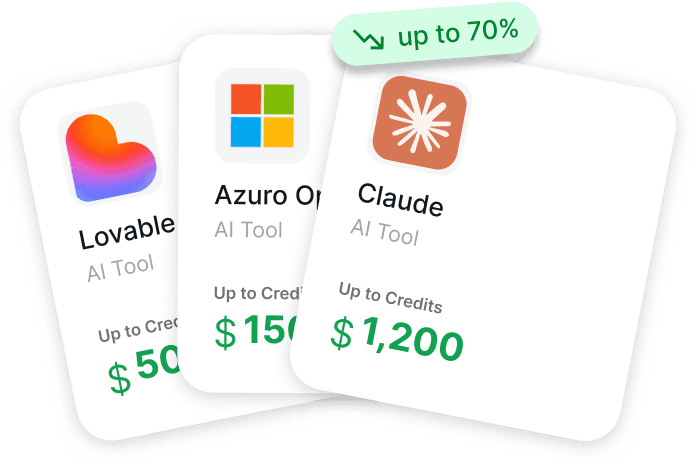
That card shows who qualifies and how to claim. AI Perks tracks more student offers beyond it, so you can stack credits while your school catches up.
OpenAI describes ChatGPT Edu as "an accessible option for universities to deploy AI to students, faculty, researchers, and campus operations." The setup is campus-level, so a school has to arrange it with OpenAI. You cannot buy it yourself as an individual.
Top AI Credits for Startups
Apply directly through these verified programs.

ChatGPT $80
Eligible for early-stage startups

Google Gemini $240
Eligible for early-stage startups

GitHub Up to $120
Eligible for early-stage startups

Notion $120
Eligible for early-stage startups

Figma $1,080
Eligible for early-stage startups

Perplexity $84
Eligible for early-stage startups
What features does ChatGPT Edu include?
The plan gives much higher message limits than the free version of ChatGPT. It also adds research and analysis tools, and it is built for sharing work across a campus.
- Data analysis, web browsing, file integrations and document summarization
- Custom GPTs for specific projects, courses or tasks, shared within university workspaces
- Support for more than 50 languages
- Security and privacy controls, plus extra admin features for schools and universities
Those admin features matter to the school more than to you. They let IT teams manage a whole campus workspace instead of thousands of separate accounts.
How much does ChatGPT Edu cost?
OpenAI does not publish a per-seat price for ChatGPT Edu. Its help page tells schools to reach out to the team for details, so pricing is negotiated per institution.
What you can see is how schools pass it on. At the University of Colorado, the cost comparison is plain:
| Plan | Cost at CU | Usage limits | Ads |
|---|---|---|---|
| ChatGPT Edu | Free | Equal to Plus license limits | No ads |
| Public ChatGPT Free | Free | Lowest limits | Ads shown |
| ChatGPT Plus | $20 per month | Higher than Free | No ads |
| ChatGPT Pro | Starts at $100 per month | Higher than Plus | No ads |
Stanford splits its rollout into two tiers. The Standard tier is free to all active faculty, students, postdocs and staff, and it matches the models and features of a $20 per month Enterprise plan. The paid Pro tier is for heavy users and is comparable to a $200 per month Enterprise plan.
Top AI Credits for Startups
Apply directly through these verified programs.
ChatGPT $80
Eligible for early-stage startups
Google Gemini $240
Eligible for early-stage startups
GitHub Up to $120
Eligible for early-stage startups
Notion $120
Eligible for early-stage startups
Figma $1,080
Eligible for early-stage startups
Perplexity $84
Eligible for early-stage startups
How do students get ChatGPT Edu through their school?
Access comes from your university, usually by affiliation. Each school runs its own rollout, so the details differ.
- Stanford: access opened to the community on June 30, 2026. IT cannot increase or reset usage limits.
- University of Colorado: the system announced its partnership on Feb. 10, 2026, covering all four campuses. Student access was delayed until August 14, 2026 at the Faculty Council's request, while faculty and staff kept the original schedule.
- CSU Bakersfield: workspace invitations are sent automatically based on your university affiliation.
- USC: Deep Research is capped at 5 queries a day and image generation at 3 images a day.
Some schools add conditions. CU Boulder users must complete a training course on responsible use before they start. CU also says advanced tools such as Codex and API access arrive in fall 2026 or later.
Check your school's IT or AI page first. If it lists a ChatGPT Edu workspace, that is your free route.
Is ChatGPT Edu private and secure?
OpenAI says it does not use ChatGPT Edu data or conversations to train its models. Stanford and CSU Bakersfield say the same about their workspaces.
On security, OpenAI lists the following:
- SOC 2 Type 2 certification
- ISO 27001, 27017, 27018 and 27701 certification
- Encryption at rest (AES-256) and in transit (TLS 1.2+)
CU draws a sharp line against the public app. Public ChatGPT uses user data and conversations to train models by default, while CU's Edu workspace is approved for CU public and confidential data. CU also says all content is stored and processed in the United States. Keck Medicine of USC users can request a HIPAA-compliant workspace.
Top AI Credits for Startups
Apply directly through these verified programs.
ChatGPT $80
Eligible for early-stage startups
Google Gemini $240
Eligible for early-stage startups
GitHub Up to $120
Eligible for early-stage startups
Notion $120
Eligible for early-stage startups
Figma $1,080
Eligible for early-stage startups
Perplexity $84
Eligible for early-stage startups
What if your school has no ChatGPT Edu deal?
You still have options. The free version of ChatGPT is available to everyone, though CU notes it has the lowest limits and shows ads to free users.
Verified U.S. K-12 educators can get a free ChatGPT for Teachers plan through June 2027. See ChatGPT for Teachers 2026: Free for Verified Educators. The ChatGPT Plus student offer has closed, so it is no longer available.
The better move is credits. These catalogue perks need no campus contract, and each card shows who qualifies and how to claim:
| Company | Free credits | How to get |
|---|---|---|
| OpenAI Codex (students) | $100 | Get this perk |
| Claude (researchers) | $240 per seat | Get this perk |
| Google Gemini (students) | $240 | Get this perk |
| Notion (education) | $120 | Get this perk |
Total: $100 + $240 + $240 + $120 = $700 in listed credits, with Claude's $240 counted per seat.
For a closer look at the coding side, read Codex for Students 2026: $100 in Free Codex Credits. For the research side, see Claude for Education 2026: What Campuses and Students Get.
How do you get started? Step by step
- Get credits through AI Perks. Open the AI Perks catalogue, filter for student and education perks, and open the cards that fit your work. Each card shows who qualifies and how to claim.
- Check your school's IT or AI page. Look for a ChatGPT Edu workspace. Stanford, CU, CSU Bakersfield and USC all publish theirs.
- Watch for your invitation. At some schools, such as CSU Bakersfield, invitations go out automatically by affiliation.
- Finish any required training. CU Boulder asks users to complete a course before first use.
- Know your limits. USC's daily caps on Deep Research and images show that campus plans have ceilings. Plan heavy work around them, or use credits for the overflow.
- Keep sensitive work in the school workspace. That is where the no-training and data-handling protections apply.
For more options, compare Free AI Credits for Students 2026: Every Program Compared.
Top AI Credits for Startups
Apply directly through these verified programs.
ChatGPT $80
Eligible for early-stage startups
Google Gemini $240
Eligible for early-stage startups
GitHub Up to $120
Eligible for early-stage startups
Notion $120
Eligible for early-stage startups
Figma $1,080
Eligible for early-stage startups
Perplexity $84
Eligible for early-stage startups
FAQ
Can I buy ChatGPT Edu myself?
No. ChatGPT Edu is a campus-level setup that a school arranges with OpenAI, and OpenAI tells schools to reach out to its team. If your university has no deal, look at free student credits in the AI Perks catalogue instead.
Is ChatGPT Edu free for students?
It depends on the school. At Stanford the Standard tier is free to all active faculty, students, postdocs and staff, and at CU the Edu cost is listed as free. Stanford's Pro tier is paid. Your school's IT page confirms what you get.
Does ChatGPT Edu train on my conversations?
OpenAI says no data or conversations from ChatGPT Edu are used to train its models. Stanford and CSU Bakersfield confirm this for their workspaces. CU notes that public ChatGPT trains on user data by default, which is a key difference from the Edu workspace.
What are the usage limits?
Limits are higher than free ChatGPT, and CU says Edu limits equal Plus license limits. Schools can add their own caps, such as USC's 5 Deep Research queries and 3 images a day. At Stanford, IT cannot raise or reset limits.
What can I use if my school has no ChatGPT Edu?
Free ChatGPT is open to everyone, and credits can fill the gap. The AI Perks catalogue lists student and education perks, including $240 in Google Gemini credits. Each card shows who qualifies and how to claim.
Is the ChatGPT Plus student offer still open?
No. The ChatGPT Plus student offer has closed. For current student deals, see AI Student Discount 2026: Every Verified Offer Listed or browse getaiperks.com.
Ready to find free AI credits?
ChatGPT Edu depends on your school, but credits do not. Open the cards, check who qualifies and claim what fits.
Get free AI credits at getaiperks.com →
Browse every student and education perk, with amounts and claim details, at getaiperks.com.

