Quick Summary: OpenAI pricing varies significantly across its product lines. ChatGPT offers free access with paid plans ranging from $8/month (Go) to custom enterprise pricing. API developers pay per token: GPT-5.4 costs $2.50 per million input tokens and $15.00 per million output tokens, while smaller models like GPT-5-mini start at $0.250 per million input tokens. Understanding these pricing structures helps organizations optimize their AI spending.
OpenAI has transformed from an AI research lab into one of the most commercially significant technology platforms of the decade. With ChatGPT holding a significant share of the AI search market, millions of individuals and organizations worldwide now depend on OpenAI’s tools for everything from content creation to complex coding tasks.
But here’s the thing—understanding what OpenAI actually costs isn’t straightforward. The company offers multiple product lines with dramatically different pricing models. ChatGPT uses subscription tiers. The API charges per token. And enterprise solutions? Those require custom quotes.
This guide breaks down every pricing structure OpenAI offers in 2026, from the free ChatGPT tier to the most advanced API models. Whether evaluating costs as a developer, comparing subscription plans as an individual, or managing AI budgets for an organization, the information below provides the clarity needed to make informed decisions.
How OpenAI Pricing Actually Works
OpenAI operates two distinct pricing ecosystems that serve different user types. Understanding which one applies to specific use cases determines what costs to expect.
The first ecosystem covers ChatGPT—the conversational interface most people recognize. These plans use subscription pricing where users pay a fixed monthly or annual fee for access. Costs remain predictable regardless of usage volume within plan limits.
The second ecosystem serves developers through the OpenAI API. This model charges based on actual consumption, measured in tokens. A token represents roughly four characters of text, meaning longer inputs and outputs cost more than shorter ones.
The Token-Based Billing Model
For API users, tokens form the fundamental billing unit. When making an API call, both the input (prompt sent to the model) and output (response generated) consume tokens. Different models charge different rates per million tokens.
According to the official OpenAI pricing page, GPT-5.4—their most capable model for professional work—costs $2.50 per million input tokens and $15.00 per million output tokens under standard processing. That’s standard rates for context lengths under 270K tokens.
But wait. There’s also cached input pricing. When the API recognizes previously processed input that≻s still in cache, the rate drops to $0.25 per million tokens—a 90% discount. This caching mechanism significantly reduces costs for applications that repeatedly use the same context.
Smaller models cost substantially less. GPT-5-mini charges $0.250 per million input tokens (10% of GPT-5.4’s standard rate) and $2.000 per million output tokens. For lightweight tasks with well-defined parameters, these smaller models deliver massive cost savings.
Subscription vs. Pay-Per-Use
The choice between ChatGPT subscriptions and API access depends entirely on use patterns. Subscriptions make sense for individuals who want consistent access without tracking usage. The predictable monthly cost covers unlimited conversations within rate limits.
API pricing suits developers building applications where AI forms one component of a larger system. Pay-per-use means costs scale with actual demand rather than flat fees. During development or low-traffic periods, expenses stay minimal.
Organizations sometimes use both. Teams might provide ChatGPT Business subscriptions for general employee use while maintaining API access for product integrations.
ChatGPT Subscription Plans Breakdown
OpenAI offers six distinct ChatGPT subscription tiers as of March 2026. Each targets different user segments with progressively advanced features.

Free Plan
The free tier provides access to GPT-5 mini, OpenAI’s efficient frontier model. While less capable than newer versions, GPT-3.5 handles basic conversations, simple questions, and straightforward content drafting.
Message limits apply. During high-demand periods, free users experience slower response times as paid subscribers receive priority. Image generation capabilities are limited, and access to newer features like deep research or extended memory isn’t available.
For someone exploring what ChatGPT can do or needing occasional AI assistance, the free plan delivers genuine value without financial commitment.
ChatGPT Go: The New Mid-Tier Option
OpenAI introduced ChatGPT Go, initially launching in India before expanding globally. At $8 per month, it represents a significant discount compared to Plus.
Go subscribers gain access to GPT-5.2 Instant—a faster, more capable model than GPT-3.5 but not as advanced as GPT-5.3. The plan offers expanded usage limits, extended memory to reference past conversations, and improved image generation capabilities.
According to OpenAI’s announcement, ChatGPT Go became their fastest-growing plan. The company also indicated they’ll begin testing ads in the free and Go tiers, allowing them to keep subscription costs lower while offsetting operational expenses.
ChatGPT Plus: The Popular Choice
At $20 per month, ChatGPT Plus targets power users who need consistent access to OpenAI’s most advanced publicly available models. Subscribers get GPT-5.3, which offers significantly better reasoning, creativity, and accuracy compared to earlier versions.
Plus includes priority access during peak times, faster response speeds, and access to all standard features including image generation, deep research capabilities, and the ability to upload and analyze files.
This tier represents the sweet spot for professionals who rely heavily on ChatGPT but don’t need the extended thinking time or unlimited access that Pro offers.
ChatGPT Pro: Maximum Performance
The Pro plan costs $200 per month—ten times the Plus subscription. That steep price targets a specific audience: researchers, scientists, developers, and professionals working on complex problems where extended reasoning time delivers substantial value.
Pro subscribers access GPT-5.3 Pro mode, which allows the model to spend more time processing before responding. For mathematical proofs, complex coding challenges, or multi-step analysis, this extended thinking produces noticeably better results.
The plan also offers unlimited message generation. While Plus users hit message limits during intensive sessions, Pro subscribers can generate unlimited responses throughout the day.
ChatGPT Business: Team Collaboration
Business plans start at $30 per user per month according to the ChatGPT pricing page (listed as €29 with annual billing in some regions). Monthly billing options cost slightly more.
This tier adds collaborative features that individual plans lack: shared workspaces where team members can access and build on each other’s conversations, administrative controls for managing user access, and enhanced security features suitable for professional environments.
Business subscribers also gain access to all models including GPT-5.3, priority support, and higher usage limits than Plus. Organizations needing a minimum of two seats can start with Business without committing to enterprise-level contracts.
OpenAI renamed ChatGPT Team to ChatGPT Business to better reflect its purpose for team collaboration. The features and pricing remained the same—only the branding changed.
ChatGPT Enterprise: Custom Solutions
Enterprise plans don’t have published pricing. Organizations contact OpenAI’s sales team for custom quotes based on their specific needs, user count, and required features.
Enterprise includes everything in Business plus additional capabilities like single sign-on (SSO) integration, advanced admin controls, data residency options, unlimited context windows for processing longer documents, and dedicated support from OpenAI’s team.
For companies deploying AI across hundreds or thousands of employees, Enterprise provides the infrastructure, security, and support needed to manage ChatGPT at scale.
OpenAI API Pricing for Developers
The API pricing model differs fundamentally from ChatGPT subscriptions. Developers building applications pay only for actual usage, measured in tokens processed.
This consumption-based approach means costs scale directly with application traffic. Low-traffic projects remain inexpensive while high-volume production systems require careful cost optimization.
Current GPT Model Pricing
According to OpenAI’s official pricing documentation, here’s what developers pay for text generation as of March 2026:
| Model | Input (per 1M tokens) | Cached Input (per 1M tokens) | Output (per 1M tokens) |
|---|---|---|---|
| GPT-5.4 | $2.50 | $0.25 | $15.00 |
| GPT-5.4-pro | $15.00 | — | $90.00 |
| GPT-5.2 | $0.875 | $0.0875 | $7.00 |
| GPT-5.1 | $0.625 | $0.0625 | $5.00 |
| GPT-5 | $0.625 | $0.0625 | $5.00 |
| GPT-5-mini | $0.250 | $0.025 | $2.000 |
| GPT-5-nano | $0.025 | $0.0025 | $0.20 |
The price differences reveal strategic choices. GPT-5.4-pro costs six times more than standard GPT-5.4 for input and output—that premium buys extended reasoning capabilities similar to ChatGPT Pro mode.
For applications where speed and cost matter more than maximum intelligence, GPT-5-mini delivers solid performance at one-tenth the price. GPT-5-nano pushes costs even lower for simple classification or extraction tasks.
Batch Processing Discounts
The Batch API offers 50% off both input and output tokens compared to standard rates. This discount applies when applications can process requests asynchronously rather than needing immediate responses.
So GPT-5.4 input through Batch API costs $1.25 per million tokens instead of $2.50, while output drops to $7.50 from $15.00. For workflows like overnight content analysis, bulk data processing, or any task where 24-hour turnaround works, batch processing cuts API costs in half.
Video Generation Pricing: Sora Models
OpenAI’s Sora video generation models use per-second pricing rather than token-based billing. According to the official pricing page, rates vary by model and resolution:
| Model | Resolution | Price per Second |
|---|---|---|
| sora-2 | 720×1280 (Portrait) or 1280×720 (Landscape) | $0.10 |
| sora-2-pro | 720×1280 (Portrait) or 1280×720 (Landscape) | $0.30 |
| sora-2-pro | 1024×1792 (Portrait) or 1792×1024 (Landscape) | $0.50 |
Video costs add up quickly. A 30-second clip at standard resolution with sora-2 costs $3.00, while the same duration at higher resolution with sora-2-pro runs $15.00. Applications generating substantial video content need careful budgeting.
Container Usage and Regional Processing
As of March 31, 2026, OpenAI changed how container usage is billed—shifting from per-container charges to per-20-minute-session billing. The rates themselves remain unchanged across memory tiers:
- 1 GB (default): $0.03 per 20-minute session
- 4 GB: $0.12 per 20-minute session
Data residency and Regional Processing endpoints carry an additional 10% surcharge for GPT-5.4 models. Organizations with compliance requirements mandating data storage in specific geographic regions should factor this premium into cost projections.
Realtime API Costs
The Realtime API enables conversational AI experiences with voice input and output. Billing works differently than standard text APIs because it processes multiple modalities: text, audio, and images.
Audio tokens are calculated based on duration. User messages consume 1 token per 100 milliseconds of audio, while assistant messages use 1 token per 50 milliseconds. A 10-second user utterance equals 100 tokens, while a 10-second AI response equals 200 tokens.
Token costs vary by model—check the specific model pages for current Realtime API pricing. The conversational nature of these interactions, with context maintained across multiple turns, means token usage accumulates throughout sessions.
Comparing Value Across OpenAI Plans
Real talk: determining which OpenAI plan offers the best value depends entirely on use patterns. A $200/month Pro subscription seems expensive until considering that a developer making equivalent API calls could easily exceed that cost.
Individual Users: When to Choose Each Plan
Casual users who check ChatGPT a few times weekly should stick with the free plan. The limitations won’t significantly impact occasional use.
Regular users who interact with ChatGPT daily but don’t need cutting-edge models benefit from ChatGPT Go at $8/month. The expanded limits and improved model justify the modest cost for consistent users.
Power users—writers, developers, researchers, or professionals who rely on ChatGPT for multiple hours daily—find the Plus plan worth every dollar of its $20 monthly fee. Priority access alone eliminates frustrating delays during peak hours.
The Pro plan makes financial sense only for specific professional scenarios: complex research requiring extended reasoning, coding projects where deeper analysis saves hours of debugging, or consulting work where better AI output directly generates revenue exceeding $200 monthly.
Organizations: Subscription vs. API Strategy
Small teams (2-10 people) needing collaborative AI access should evaluate ChatGPT Business first. At $30 per user monthly, a five-person team pays $150—less than a single Pro subscription while providing team workspace features and administrative controls.
Developers building applications face different math. For products where users trigger AI interactions, API pricing ensures costs scale proportionally with revenue. A startup with 100 daily users might spend $50 monthly on API calls, while a successful product with 10,000 users might spend $5,000—but that higher cost correlates with higher usage and (presumably) revenue.
Many organizations use hybrid approaches. Sales and marketing teams might have ChatGPT Business subscriptions for daily work, while the engineering team uses API access for product features. This combination optimizes for both predictable employee costs and scalable product infrastructure.
Factors That Drive OpenAI Costs
Several variables significantly impact total OpenAI expenses beyond base pricing. Understanding these factors enables better cost prediction and optimization.
Token Efficiency and Prompt Engineering
The way prompts are structured dramatically affects token consumption. Verbose instructions that repeat context burn through input tokens unnecessarily. Well-crafted prompts that efficiently communicate requirements use fewer tokens while often producing better outputs.
For API developers, implementing prompt engineering best practices directly reduces costs. A prompt optimized from 500 tokens to 200 tokens cuts input costs by 60% per request—savings that compound across millions of API calls.
Model Selection Strategy
Not every task requires the most advanced model. Content summarization, simple classification, or basic Q&A often works perfectly fine with GPT-5-mini or GPT-5-nano at a fraction of GPT-5.4’s cost.
Sophisticated applications implement model routing: simpler queries go to cheaper models while complex requests use premium models. This tiered approach balances cost efficiency with output quality.
Caching Opportunities
The 90% discount on cached input represents OpenAI’s most substantial cost reduction mechanism. Applications that repeatedly use the same context—like a long system prompt, product documentation, or knowledge base—should structure requests to maximize cache hits.
According to OpenAI’s documentation, input that matches previously processed content and remains in cache costs $0.25 per million tokens instead of $2.50 for GPT-5.4. For applications processing thousands of requests with shared context, this discount alone can reduce costs by 80% or more.
Usage Patterns and Rate Limits
ChatGPT subscriptions include usage limits that reset periodically. Users who consistently hit these limits during high-intensity work sessions might find the next tier’s expanded limits necessary despite higher costs.
API users face rate limits measured in tokens per minute (TPM). These limits increase with tier level—from 500,000 TPM on the free tier to 40,000,000 TPM at Tier 5 for GPT-5.4. Applications requiring higher throughput need to factor rate limit upgrades into cost calculations.
Cost Optimization Strategies
Organizations spending thousands monthly on OpenAI can implement several strategies to reduce expenses without sacrificing functionality.
Implement Smart Caching
Structure applications to maximize cached input usage. Place static instructions and context at the beginning of prompts where they’re most likely to cache. Avoid unnecessarily changing preamble text that could otherwise remain cached across requests.
For conversational applications, maintain conversation history efficiently. Rather than resending the entire conversation on each turn, use OpenAI’s conversation management features that automatically handle context without repeatedly charging for the same tokens.
Use Batch Processing Where Possible
The 50% discount for Batch API processing applies to any workload that doesn’t need real-time responses. Data analysis, content moderation, report generation, or any overnight processing task should route through Batch API by default.
Even shifting just 30% of API volume to batch processing can reduce total costs by 15%. For high-volume applications, that percentage translates to significant monthly savings.
Right-Size Model Selection
Audit which requests actually require premium models. Many applications default to GPT-5.4 for everything when 40-60% of queries would work fine with GPT-5-mini or even GPT-5-nano.
Implement classification logic that routes requests to appropriate models based on complexity. Simple questions, basic formatting tasks, or straightforward extractions rarely need flagship model capabilities.
Monitor and Set Budget Alerts
OpenAI’s platform includes usage monitoring and budget alert features. Organizations should establish monthly spending thresholds and configure notifications before approaching limits.
Regular usage analysis identifies unexpected cost spikes. Sudden increases often indicate inefficient code, runaway loops, or abuse that needs addressing before generating massive bills.
Consider Fine-Tuning for Specialized Tasks
For applications with very specific, repeated tasks, fine-tuning smaller models can deliver better results at lower cost than using larger base models. While fine-tuning requires upfront investment, the ongoing savings from using smaller, specialized models often justify the effort for high-volume use cases.

Claim OpenAI Credits Before Scaling Your API Usage
OpenAI pricing is usage based, which means costs can grow quickly once AI features move from testing into production. Tokens, API calls, and model usage add up as more workflows rely on AI. Many startups pay full price for this infrastructure without realizing that vendor credit programs may already exist.
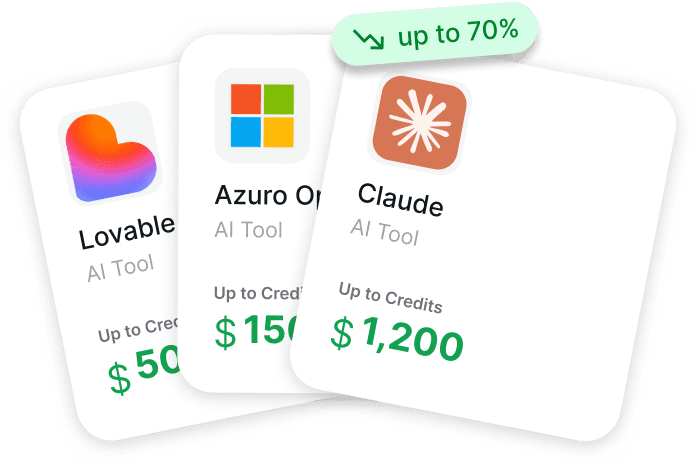
Get AI Perks lists startup credits and discounts for AI and SaaS tools in one place, including offers such as up to $10,000 in OpenAI credits, $2,500 in additional API credits, and up to $150,000 in Azure credits that can be used with OpenAI models. Instead of searching for vendor programs individually, founders can review available perks and see their approval likelihood before applying.
Check Get AI Perks first and claim available OpenAI credits before scaling your API usage.
Comparing OpenAI to Competitor Pricing
OpenAI doesn’t operate in a vacuum. Anthropic, Google, and other providers offer competitive AI models with different pricing structures.
Generally speaking, OpenAI’s pricing sits in the mid-to-premium range. Some competitors offer lower per-token costs, particularly for less capable models. However, OpenAI’s models often require fewer tokens to achieve the same output quality, which can offset higher per-token prices.
For organizations evaluating multiple providers, the effective cost per task matters more than raw per-token pricing. A model that costs 20% more but requires 30% fewer tokens to accomplish the same goal actually costs less overall.
Common OpenAI Pricing Questions
What payment methods does OpenAI accept?
OpenAI accepts major credit cards (Visa, Mastercard, American Express) for both ChatGPT subscriptions and API usage. Enterprise customers can arrange invoice billing and purchase orders through the sales team.
Are there educational or nonprofit discounts?
OpenAI offers special pricing for educational institutions through ChatGPT Education plans. Nonprofits should contact the sales team to discuss potential discounts. The free tier remains available to all users regardless of organization type.
How does billing work for API usage?
API usage operates on a prepaid credit system. Users add credits to their account, and costs are deducted as API calls are made. When credits run low, automatic recharge can be enabled, or manual top-ups can be done as needed. Detailed usage breakdowns are available in the account dashboard.
Can ChatGPT subscription costs be expensed?
Subscriptions used for professional work are typically tax-deductible business expenses. Business and Enterprise plans include proper invoicing for corporate expense reporting. Individual users should consult tax professionals regarding deductibility of Plus or Pro subscriptions.
What happens if I exceed ChatGPT plan limits?
When usage limits are reached on Plus or Go plans, access throttles until the limit resets (usually within a few hours). The system doesn’t automatically charge extra—instead, it displays a message indicating when full access will resume. Pro subscriptions have no usage caps.
Do API costs vary by geographic region?
Standard API pricing applies globally. However, data residency and Regional Processing endpoints—which ensure data stays within specific geographic regions for compliance purposes—carry an additional 10% surcharge for GPT-5.4 models.
How much does OpenAI cost for a small business?
A small business with five employees using ChatGPT Business would pay approximately $150 monthly with annual billing ($30 per user). For API integration, costs depend entirely on usage volume. A small application generating 1 million GPT-5-mini tokens monthly would cost roughly $2.25 total ($0.25 input + $2.00 output per million tokens).
Are there free trial options for paid plans?
ChatGPT Business offers a free trial option—organizations can test the team workspace features before committing to paid seats. ChatGPT Plus and Pro don’t typically include free trials, but the free tier provides ample opportunity to evaluate ChatGPT before upgrading. API users receive free tier credits for initial testing.
The Bottom Line on OpenAI Pricing
OpenAI’s pricing reflects a company trying to balance accessibility with sustainability. The free tier ensures anyone can experience AI capabilities regardless of budget. Mid-tier subscriptions like Go and Plus serve the massive market of regular users willing to pay modest fees for better service.
Premium offerings—Pro subscriptions and advanced API models—target professional users where superior performance justifies higher costs. These tiers subsidize the lower-cost options while providing meaningful value to users working on complex problems.
For API developers, the token-based model aligns costs with actual usage. This consumption pricing rewards optimization and ensures startups don’t overpay during early stages while allowing mature products to scale without artificial limitations.
The key to maximizing value isn’t necessarily choosing the cheapest option. It’s understanding usage patterns, selecting appropriate models for different tasks, and implementing optimization strategies that reduce waste without sacrificing output quality.
Organizations should start by evaluating actual needs. The ChatGPT free tier serves occasional users. ChatGPT Go at $8 per month serves regular users. Plus at $20 delivers substantial value for heavy users. Pro makes sense only when extended reasoning genuinely improves outcomes worth $180 more per month.
For API users, begin with careful model selection. Default to smaller, cheaper models and upgrade to premium options only when output quality demonstrably improves. Implement caching aggressively. Route appropriate workloads to Batch API. Monitor usage patterns and optimize based on actual data rather than assumptions.
Pricing will evolve—OpenAI regularly adjusts rates as models improve and operational costs change. The company has historically decreased prices for older models while introducing newer, more expensive flagship options. This pattern likely continues as GPT-6 and future generations arrive.
Check OpenAI’s official pricing page regularly for current rates, as this guide reflects March 2026 pricing that may change. The strategic principles—understanding token economics, choosing appropriate models, implementing caching, using batch processing—remain valuable regardless of specific dollar amounts.
Ready to optimize your OpenAI costs? Start by auditing current usage patterns, identifying inefficiencies, and implementing the optimization strategies that match your use case. Whether spending $8 monthly or $8,000, the effort invested in understanding and optimizing OpenAI pricing pays dividends in both cost savings and better AI results.